gr-qc · 23 pages
From Manifolds to Condensed Spaces
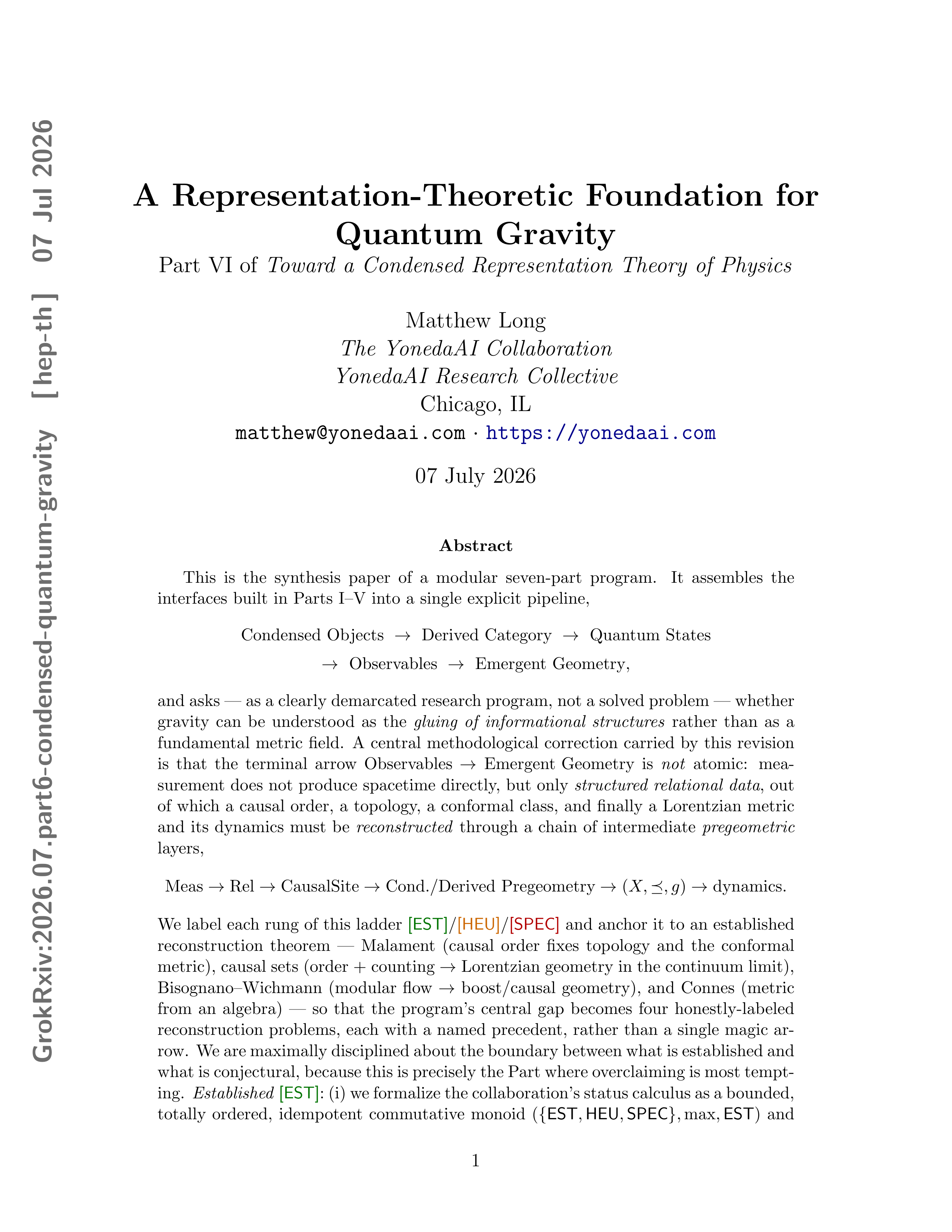
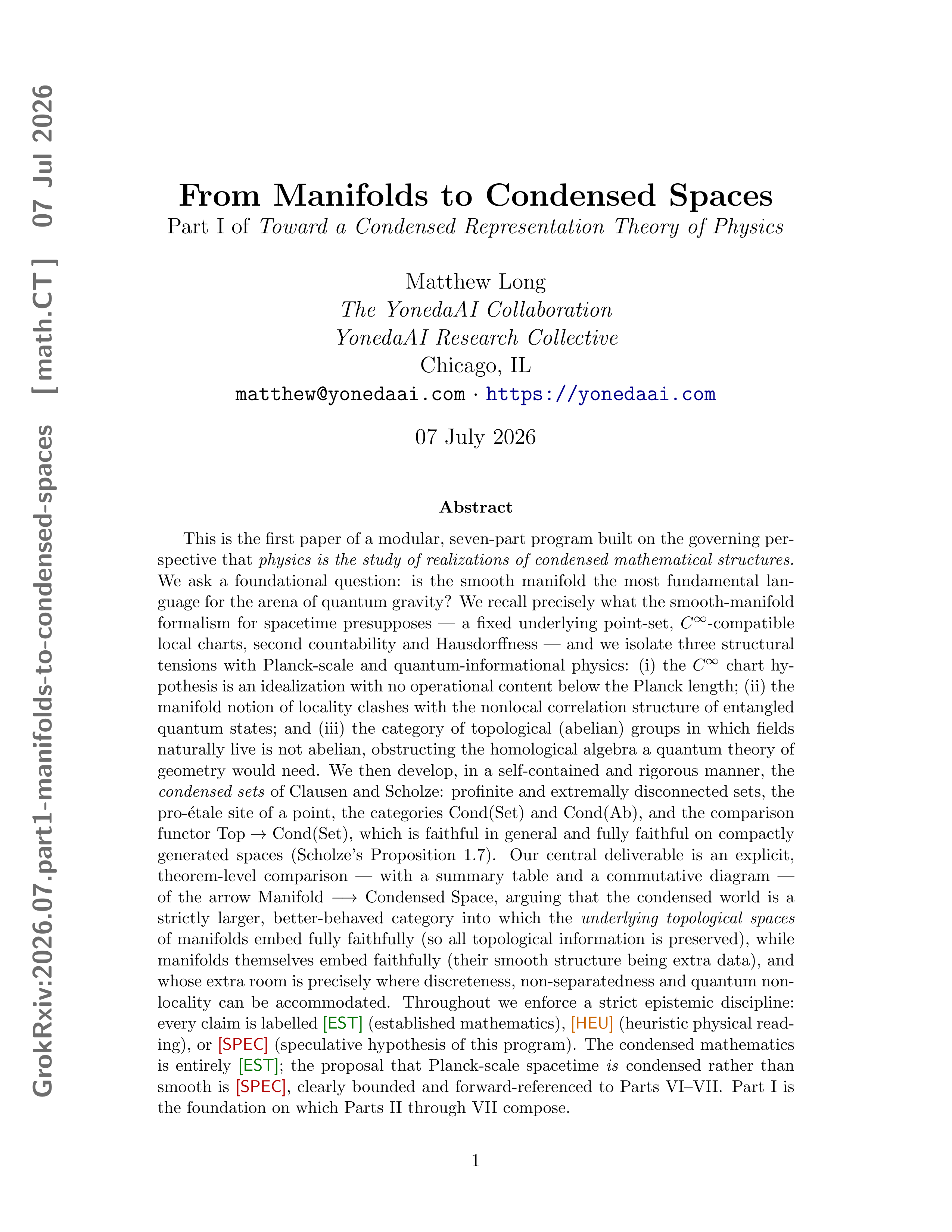
Classical general relativity models spacetime as a smooth Lorentzian manifold. Part I asks whether the smooth manifold is the most fundamental…
A Modular Research Program · Parts I–VII + Synthesis
Physics is the study of realizations of condensed mathematical structures — a modular program in seven parts.
8 papers · 223 pages · fully modular composition
Each part is a self-contained module that composes with its predecessors — the output category of one paper is the input category of the next.
gr-qc · 23 pages
Classical general relativity models spacetime as a smooth Lorentzian manifold. Part I asks whether the smooth manifold is the most fundamental…
math-ph · 27 pages
Building on Part I's condensed spaces, this paper inverts the usual order geometry-to-observables into measurement-to-relations-to-geometry. A…
quant-ph · 23 pages
Part II showed that quantum states form only a presheaf, not a sheaf, and that this failure of descent is entanglement. Part III develops condensed…
hep-th · 23 pages
A classical field is a map from a manifold to a coefficient space. This paper asks whether the manifold can be demoted from presupposed background to…
math.CT · 24 pages
Tannakian duality, Gelfand duality, Connes' spectral reconstruction, Tomita-Takesaki modular theory, and the cobordism hypothesis all recover…
gr-qc · 31 pages
This paper assembles the interfaces built in Parts I-V into a single explicit pipeline from condensed objects to emergent geometry, and asks whether…
gr-qc · 34 pages
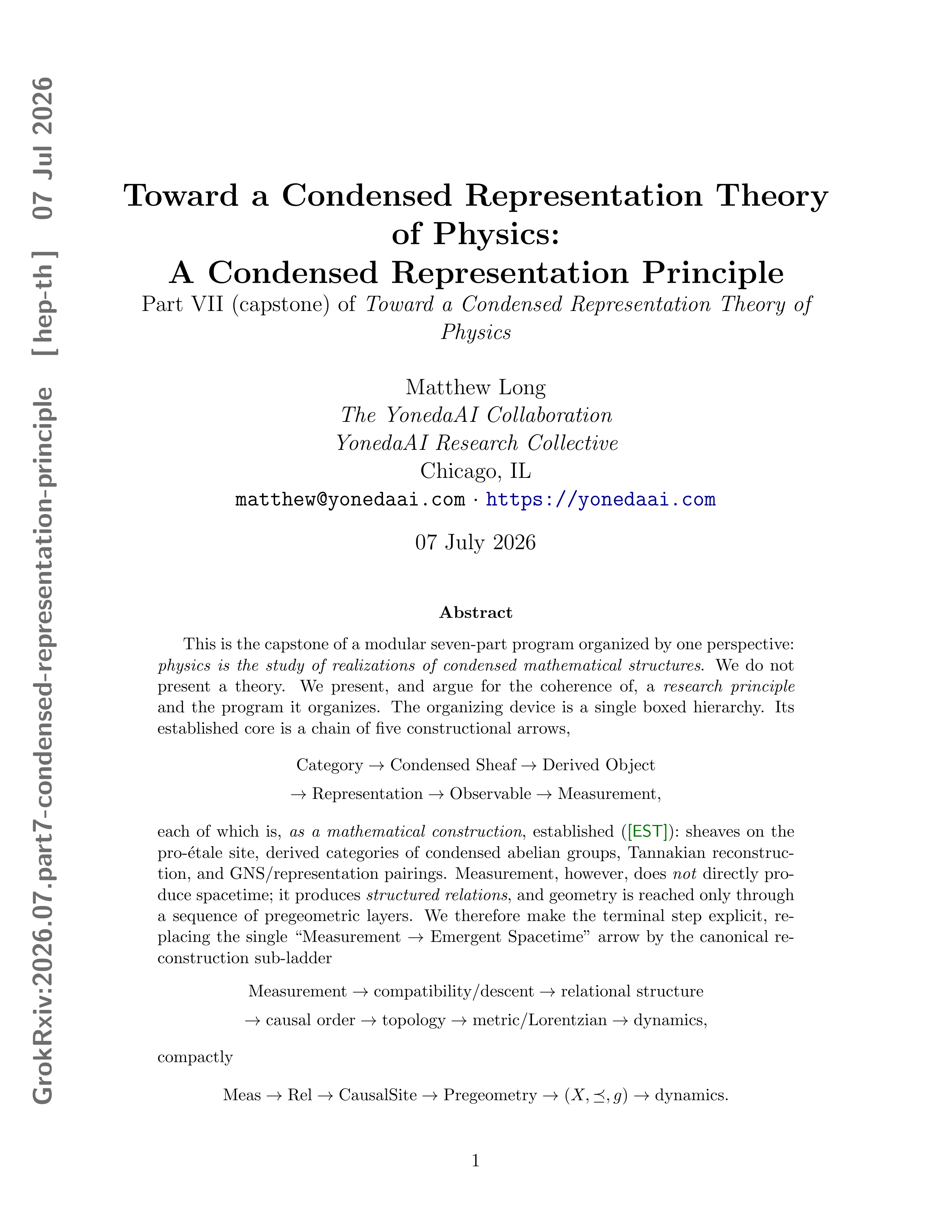
The capstone of the modular program states the Condensed Representation Principle as a research program rather than a solved theory. A Program Status…
math-ph · 38 pages
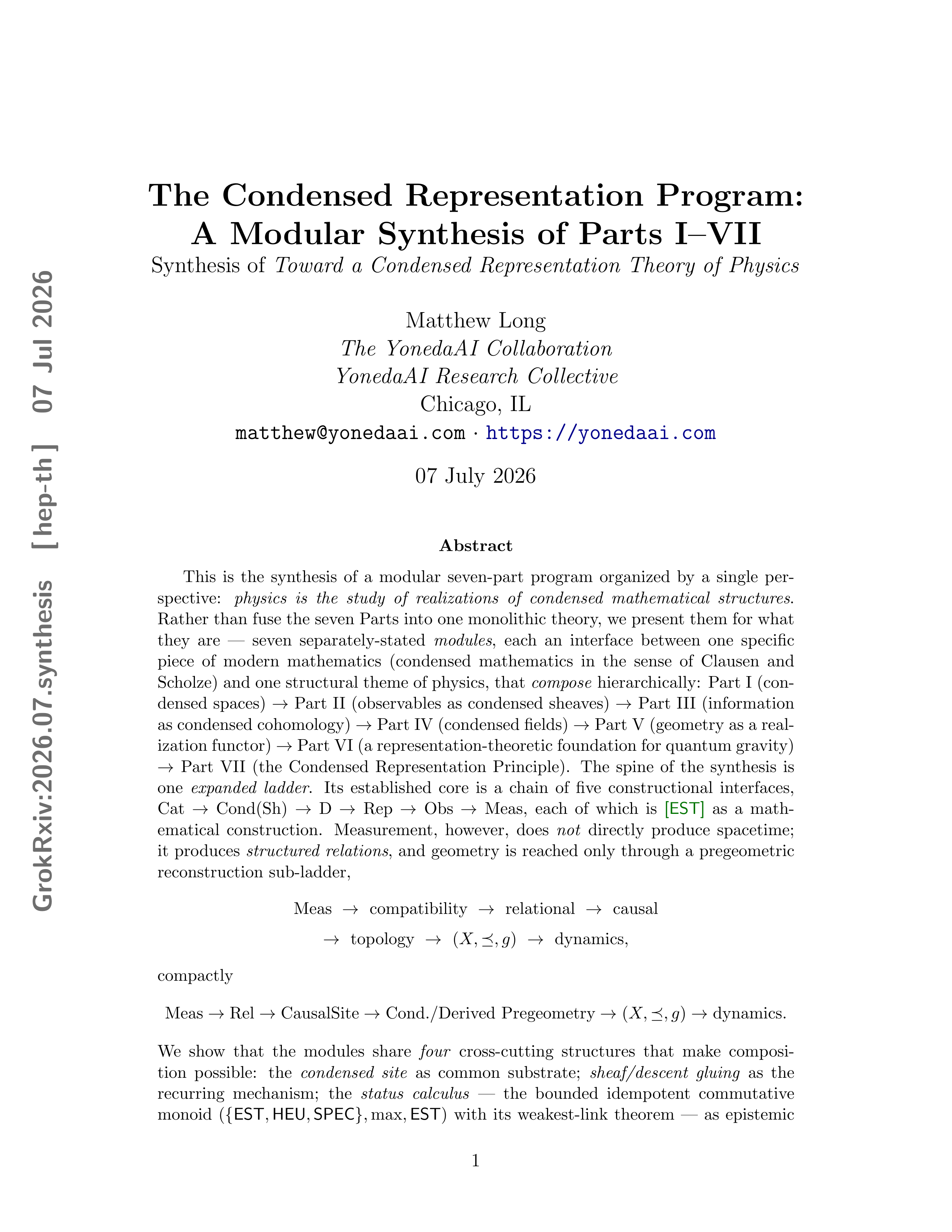
Rather than fuse the seven parts into one monolithic theory, this synthesis presents them as seven separately-stated modules that compose…
This is not a single unified theory. It is a hierarchy of eight papers, each composing upon its predecessors: space, then observables, then information, then fields, then geometry, then a representation-theoretic foundation for quantum gravity, then the capstone principle, then a synthesis. Composition creates emergent structure at every level.
Every claim across the series is labelled EST (established mathematics), HEU (heuristic physical reading), or SPEC (speculative hypothesis), composed worst-component-wins so that no chain of reasoning is stronger than its weakest link.
The substrate throughout is the condensed sets of Clausen and Scholze — a strictly larger, better-behaved category of “space” into which manifolds embed faithfully, supplying the homological algebra a quantum theory of geometry needs.
Every part is accompanied by runnable Haskell formalizing its finite, computable constructions, and the collaboration’s status calculus and core theorems are additionally formalized in Lean.